What ChatGPT Tells Campers About Your RV Park, and How to Fix It
Key takeaways
- More campers are asking AI assistants where to stay instead of scrolling search results.
- AI builds its answers from your website, Google listing, reviews and Facebook page.
- Thin, outdated or conflicting information means wrong answers, or no mention at all.
- A five-minute test shows you what campers are hearing about your park.
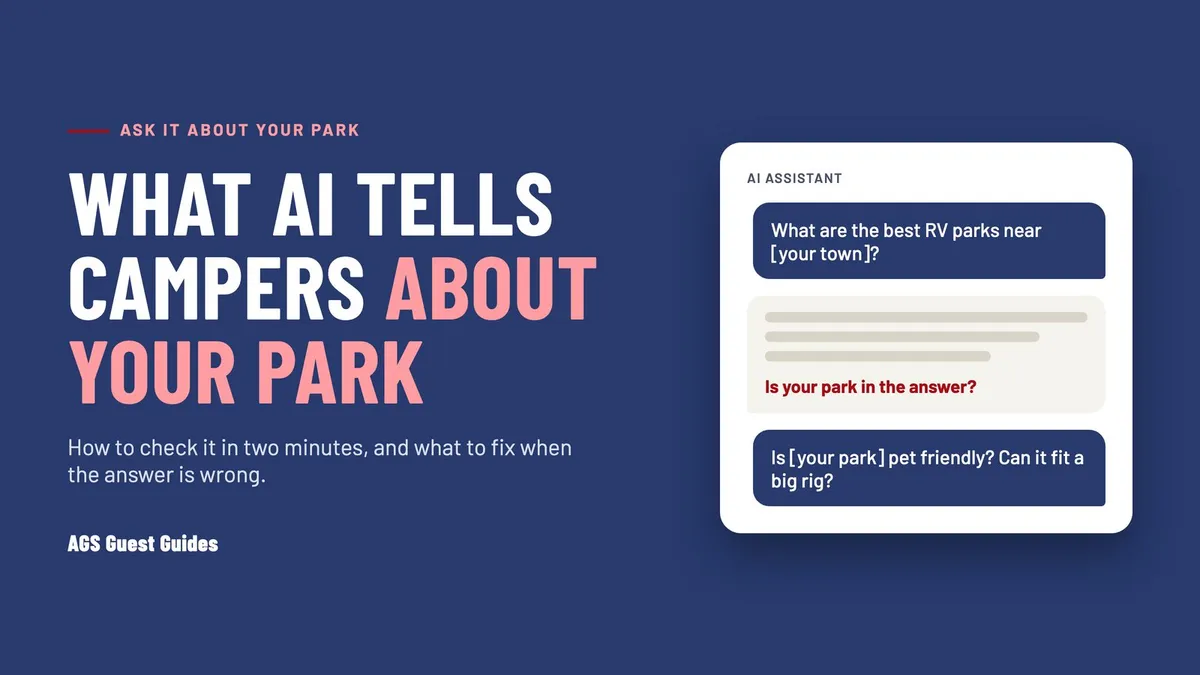
Open ChatGPT, or any AI assistant on your phone, and ask it about RV parks in your town:
"What are the best RV parks near [your town]?"
Then ask it about your park by name. What are your rates? Are you pet friendly? Can you fit a big rig? What is there to do nearby?
Did your park show up? Is what it says about you right?
The questions to ask
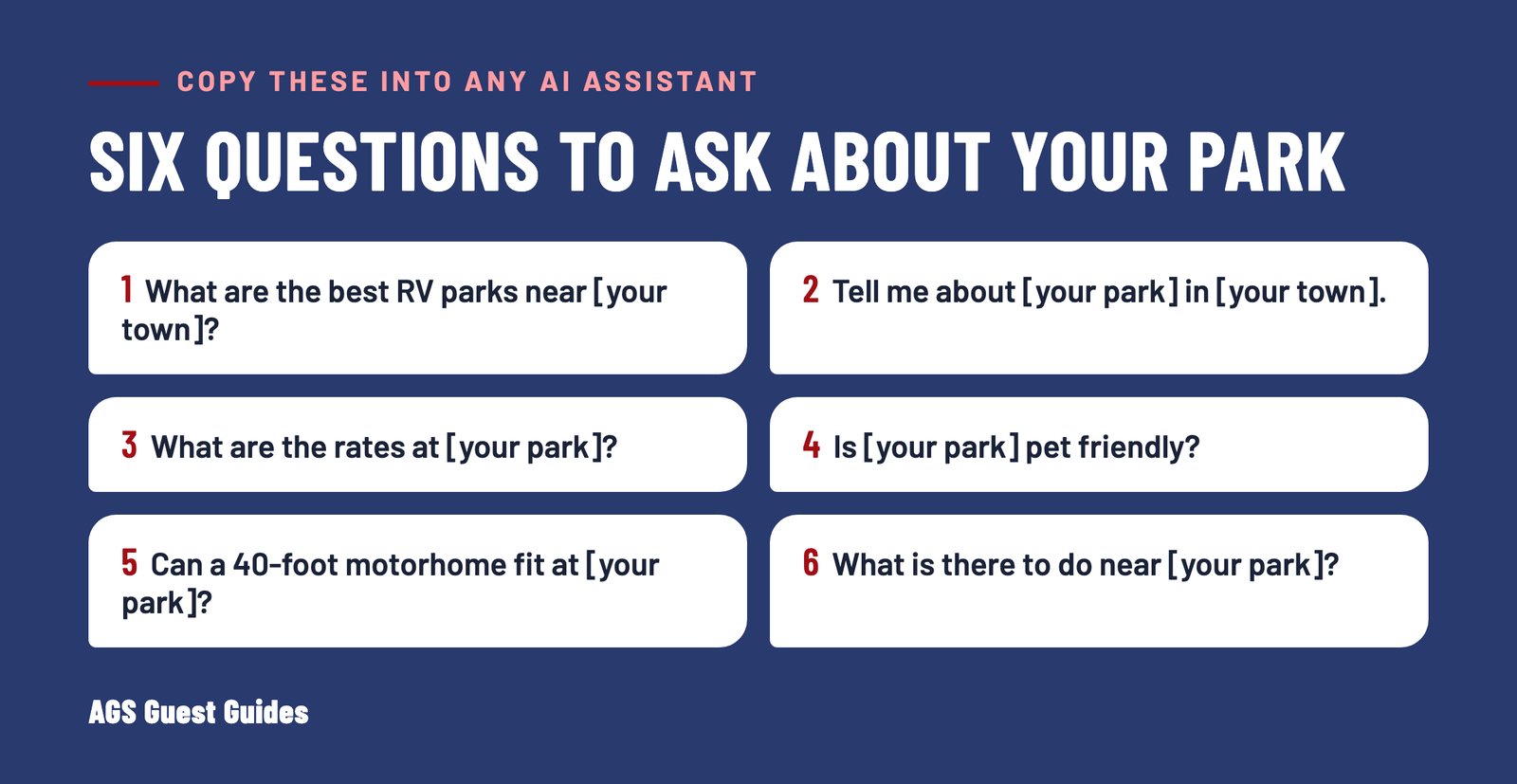
Run the test the way a camper would. Start broad, then get specific:
- "What are the best RV parks near [your town]?"
- "Tell me about [your park name] in [your town]."
- "What are the rates at [your park name]?"
- "Is [your park name] pet friendly?"
- "Can a 40-foot motorhome fit at [your park name]?"
- "What is there to do near [your park name]?"
Write down anything that is wrong, out of date or missing. Try it in more than one assistant if you can, since each one may answer differently.
Why this matters now
More campers are starting to plan trips this way, asking a question instead of scrolling through a page of search results.
Among U.S. travelers, the shift has been fast. Phocuswright found that 56% used AI to plan, book or get help during at least one trip in the past year, up from 33% in the first half of 2025. Pew Research Center reports that 44% of U.S. adults now use ChatGPT, up from 34% a year earlier, and about four in ten use chatbots to search for information. Worldwide, ChatGPT has more than 900 million weekly active users, according to OpenAI (February 2026).
Campers are earlier in that curve. In RMS's 2026 survey, 14% of campers said they now use AI tools during trip research. That is still a minority, which is exactly why now is the time to get your information right, before it becomes the way most campers ask.
The same thing is happening inside Google. Pew found that six in ten U.S. adults read the AI summaries at the top of search results, so many campers who never open ChatGPT may still see an AI answer when they search your area.
Where AI gets its answers about your park
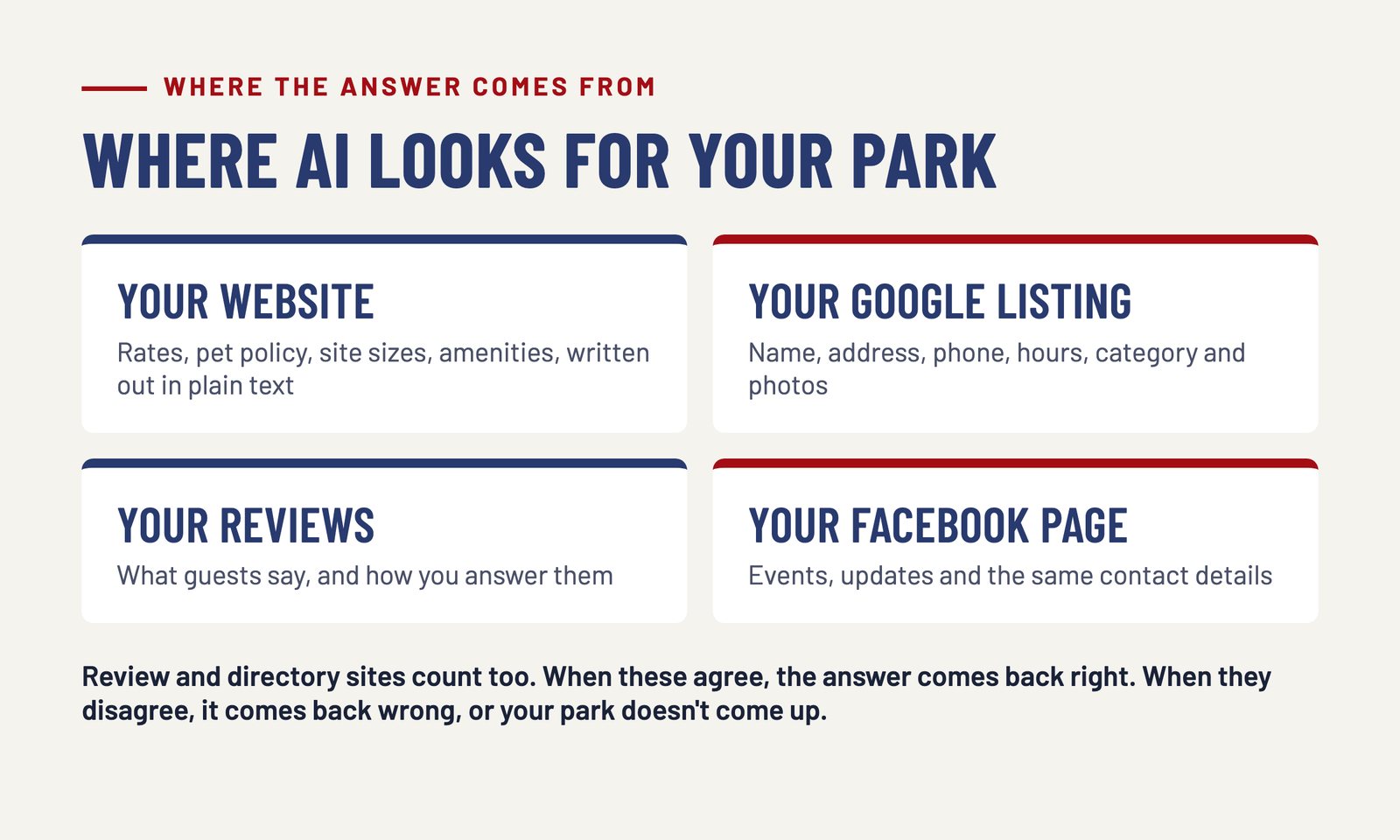
These tools draw on what is already published about your park, mostly your website, your Google listing, review and directory sites, and your Facebook page.
When that information is thin, out of date, or scattered across places that disagree, the answer comes back wrong, or your park does not come up at all. If your website says one rate, Facebook says another and your Google listing still shows last year's hours, there is no single answer for an assistant to give.
How to fix what ChatGPT says about your RV park
Start with the places you control:
1. Make your name, address and phone match everywhere
Use the exact same park name, address and phone number on your website, Google listing, Facebook page and any directory you are listed in. Small differences make it harder to tell that they are all the same park.
2. Update your Google Business Profile
Check your hours, season dates, website link, phone number, photos and amenities. Add anything missing, like pull-through sites, pet policy or Wi-Fi.
3. Put the facts on your website in plain text
Rates, pet policy, maximum rig length, hookups, amenities and what is nearby should be written out on a page, not hidden inside a PDF or an image. If a camper would ask it, answer it on your site.
4. Keep reviews coming, and reply to them
Recent reviews describe your park in campers' own words. Ask happy guests to leave one, and reply to the ones you get, good and bad.
5. Keep your Facebook page current
Update the about section, hours and contact details, and post this season's photos. An abandoned page tells everyone, people and AI alike, that nothing is happening.
Run the check again in a few weeks
Changes do not show up overnight. Some assistants pick up updates quickly and others take months, so ask the same questions again in a few weeks, compare the answers to your notes, and keep checking.
Why fall is a good time to fix it
Arrivals are slowing, and anything you update now has time to settle in before campers start planning spring and summer trips.
Your website is the one source you fully control, so it is usually the best place to start. If it needs work, our post on the ten-second phone test is a good next step.
Did not like what came back?
Send us your park's name and town. We will run the check ourselves and send you what AI is telling campers about your park, along with what to fix first.
Frequently asked questions
How do I find out what ChatGPT says about my RV park?
Open ChatGPT or any AI assistant and ask, "What are the best RV parks near [your town]?" Then ask about your park by name: your rates, whether you are pet friendly, whether you can fit a big rig, and what there is to do nearby. Check whether your park shows up and whether the answers are right.
Where does AI get information about my campground?
From what is already published about your park, mostly your website, your Google listing, review and directory sites, and your Facebook page. When that information is thin, out of date or contradictory, the answers are often wrong.
Are campers really using AI to plan trips?
More are every year. Phocuswright found 56% of U.S. travelers used AI for at least one trip in the past year. Campers are earlier in the shift: 14% of the campers RMS surveyed now use AI tools during trip research.
What should I fix first if AI gets my park wrong?
Make sure your park's name, address and phone number match everywhere, then update your Google Business Profile, and put your rates, pet policy, site sizes and amenities on your website in plain text.
Can AGS check what AI says about my park?
Yes. Send your park's name and town, and we will run the check and send you what AI is telling campers about your park, along with what to fix first.